
Sifu Sergio – Wing Chun Geeks Online Interview
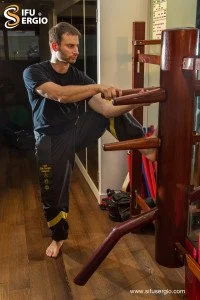
What is the best way to describe what you do? It seems like you fly all over the world documenting Wing Chun styles.
You can sum it up into two parts: I have my association, the IWKA, which is the result of my Wing Chun research. Then my passion is going everywhere interviewing Wing Chun practitioners. A few years ago I decided to share my research on my YouTube channel. I wanted to make it feel like you are coming along with me on my trips. Through my association, I do my best to pass on this knowledge.
How did you get started with Wing Chun?
In the beginning, I was a BIG Bruce Lee fan, and I lived in Amsterdam at the time. I came across Wang Kiu, a direct student of Ip Man. Shortly after that, I got my hands on the book Wing Chun Kuen by Leung Ting. After reading it, I thought, "Oh, I have to go to a Leung Ting school," and that is how I ended up in that association. I was part of it from 1988 to 2001 and was deeply involved. I was even the chief instructor of Israel.
I was under the impression you were pretty closely tied with Emin Boztepe?
There was a period, around 1994 to 1997, where I followed him all around where he held seminars. I got a lot of benefit from my training with him. I got my fighter mentality up, and he is a great fighter. I owe him a lot.
What was it like training with someone like him?
At that time, there was such a big gap in skill. In my eyes, he was like the second Bruce Lee—just amazing. I respect him a lot. A lot of people who talk crap about him obviously never touched hands with him.
Did you get to train with Leung Ting as well?
Yes, from 1997/1998 I became a private student until the end of 2001. I moved to Hong Kong and had to leave the country every three months by taking the boat to Macao or flying briefly back to Europe. In Hong Kong, I lived at a friend’s house across the street from Leung Ting’s school, and every day I had private lessons.
At the time, I had a lot of wealthy Israeli students in Amsterdam who owned hotels, and many were private students. I was very lucky—they sponsored my stay in Hong Kong. I trained privately with Leung Ting for one hour every day for about four years. After training, we would go to Dim Sum and talk about Wing Chun.
What would you talk about at Dim Sum?
We would sit down and talk, but every day wasn’t filled with great info. Leung Ting is a very special character—when he is in a bad mood, you’re not getting anything out of him. I would just join him, and he would often meet other people, like media figures or famous people like John Ladalski, who played a mafia boss in Way of the Dragon. Because of this, I got to meet lots of interesting people. Sometimes, if he was in a good mood, I would ask him quite a bit about Master Ip Man, so I learned a lot.
What was it like training with someone who trained directly under Ip Man?
I had almost finished the system in Europe at the time; we would go over the forms and I got to do a lot of Chi Sau with him. At night, I would join the normal classes and the instructor classes for training with other people and drilling. That is when I started to take an interest in other schools. In my off-time, I would travel around and see other styles.
How would other schools interpret you stopping by to see what they were training?
I’ve always been a nice guy. I would go in, and they would ask if I trained and where. Of course, they would always say, "Ours is the best," but the hands talk when you make contact. You learn to feel what is right and what is working.
I have to admit, at that time, I thought Leung Ting was the holy grail of Wing Chun. As you know, I studied many other lineages afterwards, so I don’t think like that anymore. That being said, it is THE PERSON, not the lineage. It is YOU who does the training, and YOU who makes it work. If you have two cars—a Fiat and a Ferrari—of course the Ferrari is faster, but if you don’t know how to drive it, the Fiat will win the race.
You've traveled around and seen many different styles. I was surprised by the video of you in Vietnam regarding their applications.
Ah, I know the clip you are talking about. There is something I want to make clear: people think that all the Sifus I interview and visit are my teachers or that I take lessons from them. In reality, there are very few I train with who accept me as their student. Most people I don’t really agree with, but it is something I do for the Wing Chun community to open people’s minds to what is out there.
To explain the story fully: for a while, I was studying Yuen Kay San Wing Chun. He was an acquaintance of Grandmaster Ip Man, and his style is very close to the Ip Man system. His brother immigrated to Vietnam, and because he practiced both Wing Chun and Hung Ga, he mixed them together a bit. That’s why some of the movements are different. I wanted to compare how his brother developed the system in Vietnam versus how it developed in Fut San.
After meeting all these different people, do you feel a lot of practitioners are trapped in a bubble? They theorize things but never test them out.
For sure. I was stuck in that bubble, too! From 1989 to 2001, I was really stuck in the Leung Ting system. I would shut other people down when they talked about other styles.
It was only after I completed the Leung Ting system and went to China that I realized I didn't have the holy grail. There are other lineages out there that are really special and really good. I learned that you have to open yourself up and become a student again. Not only because these guys trained hard, but because their principles and concepts made an immediate difference in my Wing Chun once I learned them.
That must have been eye-opening.
It was hard to step out of that box, but when I did, my Wing Chun improved A LOT. Now, my students all over the world benefit tremendously from my research because they have the privilege to learn Wing Chun in a much broader form.
Many people think, "Oh, this guy is mixing everything together and doesn’t know what he is doing." But here is a point I want to stress: people talk about "pure Ip Man lineage," but they often have no idea what they are talking about because Ip Man's Wing Chun is itself a mix of several lineages.
At age 9, Ip Man started learning Wing Chun from Chan Wah Sun, who died when Ip Man was only 11. How much could a 9-year-old learn in two years? Not much. He continued his studies with his senior line brothers, including Chan Wah Sun's son, Chan Yu Min, until he was around 16. It wasn’t until he met Yuen Kay San that he really started to learn. According to my research, he actually learned more from Yuen Kay San than just exchanging with him. Later, when he went to Hong Kong in the late 1940s and 1950s, he studied with people like Chu Chong Man and Tang Yick and continued to refine his system.
For example, when teaching the wooden dummy, he taught 146 movements at one period, 108 at another, and later 116. You have different students of Ip Man arguing over which version is authentic, but actually, they are all right—he was constantly tweaking his system throughout his life.
And as he got older, he changed the system structurally as well?
Yeah, exactly. He changed from a 50/50 weight stance to a rear-weighted stance.
Beyond that, what's important is the preservation of real Chinese culture. For example, Ip Man didn't learn the Dai Dak Lan Long Pole techniques until he reached Hong Kong. He learned one section of a form that originally had 18 sections. After he passed away, that single section became the "official" Long Pole form. In my opinion, it's sad because the original form was much longer, meaning a piece of the system was lost due to the fame of one man.
We have to be grateful to Bruce Lee because without him, Ip Man Wing Chun wouldn't have spread as quickly to the West. But next to Ip Man, there were many other incredible grandmasters—like Chu Chong Man, Tang Yick, and Yuen Kay San—who didn't become as famous simply because they didn't have a Bruce Lee story behind them.
In the West, Ip Man's personal interpretation became seen as the entirety of Wing Chun. Through my research, I want to show that while his Wing Chun is great, it is only one part of a much broader system. Some other lineages have Qi Gong forms and additional empty-hand forms that were lost in the Ip Man line. If we ignore those, we erase a whole part of Chinese cultural history.
To your knowledge, are there any other weapon forms in Wing Chun?
No. Legitimately, from the moment it became known as Wing Chun, it has always been the Long Pole and the Butterfly Knives. Some people claim there were other weapons very long ago, but we would have to trace the origins back to Fujian province to verify that.
How does Chi Sau differ as you travel around the world?
The framework changes. In the Leung Ting system, it is very organized with set sections. The downside is that people can get stuck in these sections and become like robots, but the benefit is that it makes it easy to teach large groups systematically.
In mainland China, it is not that organized. They teach Chi Sau as a free exercise depending on what the Sifu prefers to teach you. Positions like Poon Sau (rolling arms) as seen in famous photos of Bruce Lee and Ip Man are mainly found in the Yuen Kay San and Ip Man systems. According to my research, Fung Siu Ching was likely the creator of Poon Sau. Other families in China roll their arms in a circular fashion, which stems from the older White Crane origins.
Some other styles on the internet look almost like Tai Chi push hands with Wing Chun concepts mixed in.
Yeah, for sure. Vietnamese Wing Chun, for instance, uses very wide movements similar to Tai Chi push hands. I think that's because Yuan Chai Wan's Chi Sau was different from his brother's.
In my opinion, some lineages move too far away from the core Wing Chun concepts of economy of movement and efficiency of time, space, and energy. We don't have flying kicks in Wing Chun because they consume too much time, space, and energy.
I noticed practitioners in some Vietnamese lineages tend to bend forward more.
Yes, many do. My original Sifu did something similar, and when I asked if he learned it from Ip Man, he said yes—though Ip Man later adjusted his teaching. They claim bending forward adds force to elbow strikes, but I personally disagree with it because it breaks your centerline and exposes you.
What was it like opening a Kung Fu school in Hong Kong?
In Hong Kong, people are crazy about Western sports, MMA, Muay Thai, and Japanese martial arts like Karate, but many locals don't practice traditional Kung Fu. I was told by many people that as a foreigner, there was no way I would succeed.
So far, it's going fine. I have around 88 students in Hong Kong. About 75% are expats and 25% are locals. The hard part with expats is that they often relocate after a few years due to work, so you invest a lot of effort into training them only for them to move back home.
Where do you think someone needs to go to learn the best Wing Chun today?
In terms of hard training and fighting application, many people in Europe train harder and more realistically. But for depth of knowledge, I learned most of my Wing Chun in Hong Kong and China.
For example, I studied with Sifu Sunny So. I used to see him when he visited Europe for seminars, but it was only after I lived in Hong Kong and spent time with him two to three times a week that he truly opened up. It took years before I learned the final steps of his system. Many people think they can fly to Hong Kong for a few lessons and learn an entire system, but they don't understand the culture.
That said, for specific lines like Wong Shun Leung Wing Chun, you can learn the complete system in the West from teachers like Sifu David Peterson. But for specialized knowledge, you sometimes have to travel—I had to visit Gu Lo village four times, staying for weeks with translators, just to learn one specific piece of Gu Lo Wing Chun.
Questions From the Facebook Community
Do you make your students learn more than one form?
We teach the Ip Man lineage forms first so students get a solid overview. From there, we teach our unique IWKA Sil Lim Tao, which incorporates different elements (the water way, earth way, fire way, etc.). I personally can perform about six different versions of Sil Lim Tao.
After drilling footwork and basic hand mechanics for the first few months, students learn forms from other Wing Chun lineages, such as the Sup Yai Sau (11 Hands form), which predates modern Sil Lim Tao forms. The IWKA system is broader than standard Ip Man Wing Chun alone.
What value do the knives and pole have in a modern world?
While we don't carry poles on the street, pole training drastically improves structural angles (like your Bong Sau), tendon power, and force generation in empty-hand striking.
Weapons training also completely changes your mindset. It forces you to be hyper-focused because a mistake during weapons sparring leads to immediate feedback. Training with the knives directly improves your empty-hand angles and mechanics.
How has the rise of MMA changed your view of Wing Chun, and why don't we see it in the UFC?
There are different physical "engines" in martial arts. Ip Man Wing Chun uses what I call a "pushing engine," similar to Western boxing. Other lineages rely heavily on relaxed tendon and ligament power, throwing the fist like an iron ball on a chain, which creates tremendous energy.
Wing Chun is designed for the average person seeking practical self-defense and confidence—it isn't built for professional arena fighting. Comparing Wing Chun to MMA is comparing apples to oranges; the average person doesn't want to step into a cage.
However, MMA was a healthy wake-up call for martial artists who only viewed Wing Chun theoretically. Without hard, realistic training, nothing works. In the IWKA, we do Chi Sau sparring and glove sparring to test ourselves. You can't live in a bubble and ignore ground fighting either—that's why I spent several years studying Brazilian Jiu-Jitsu, so I could understand that dimension of fighting.
How did you manage to expand your association globally?
When I hold seminars, people who touch hands and hear the logic behind the system tend to stick around. That’s how we grew naturally to nearly 50 schools in Italy alone.
I've actually slowed down my travel schedule recently because I'm getting older and want to spend more time with my family. Instead of flying out every weekend, I now only travel for seminars once every few months.
Do you have any final training tips for students?
Make training a daily habit. Avoid bursts of extreme training followed by long breaks. Start with just 15 minutes every single day, just like brushing your teeth, and gradually build up to 1.5 or 2 hours.
When you train, eliminate all distractions. Switch off your phone, turn off your computer, and focus completely on your practice.
